
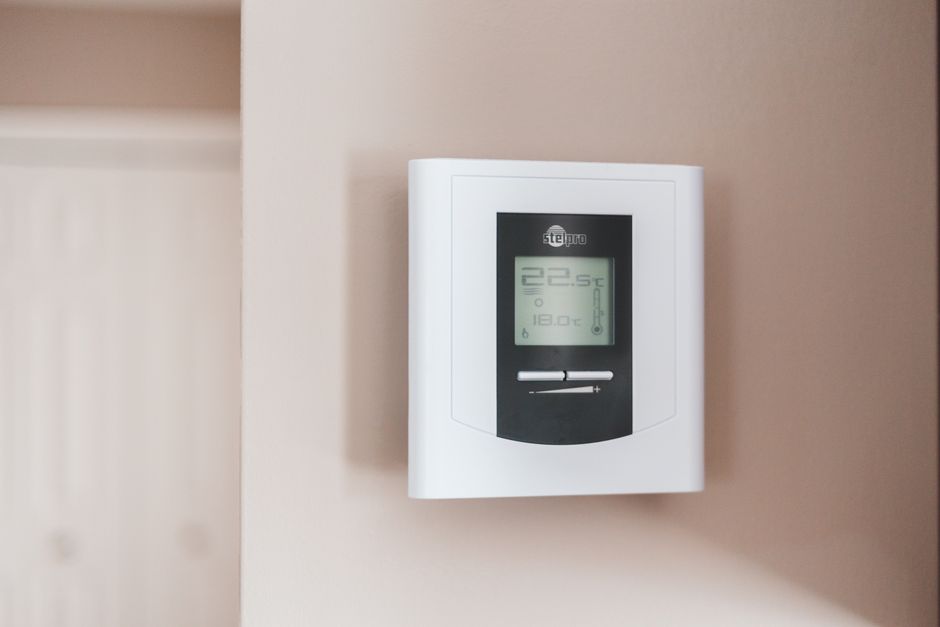
One minute you’re peeling off your sweater in the middle of winter, the next you’re shivering under a blanket. If it feels like a toddler got ahold of your body’s thermostat, you’re not imagining things. And you are definitely not alone.
This sudden internal chaos is a hallmark of perimenopause. Erratic estrogen levels disrupt the part of your brain that acts as your thermostat—the hypothalamus. This makes your body incredibly sensitive to the smallest temperature shifts, narrowing its comfort zone and causing it to overreact. In short, faulty perimenopause temperature regulation is a wiring issue, not a you issue.
So, What Exactly Is My Brain's 'Thermostat' Supposed to Do?
Deep in your brain, there's a small but mighty region called the hypothalamus. Its job is to be the master controller for your body’s core temperature, keeping it within a very narrow, stable range without you ever thinking about it. (Osilla & Sharma, 2024) It’s a silent, brilliant operator.
When everything is running smoothly, if your temperature creeps up even slightly, the hypothalamus sends signals to widen your blood vessels and make you sweat to cool off. A little cold? It triggers tiny muscle contractions to generate heat. It’s an elegant, automatic system that just… works. Until the hormonal signals it relies on start going haywire, which can also be the reason perimenopause disrupts your sleep architecture.
Why Does Perimenopause Temperature Regulation Feel So Broken?
Here’s the part no one really prepares you for: estrogen is a key player in keeping that control room running smoothly. As your estrogen levels fluctuate and fall during perimenopause, it messes with the hypothalamus’s calibration. The result is a much narrower “thermoneutral zone”—the temperature range your body tolerates before it feels the need to sound the alarm. (The Menopause Society, 2023)
Your old thermoneutral zone was probably wide and forgiving. But your new one? It’s a tightrope. Now, a tiny increase in core body temperature that you wouldn’t have even registered a few years ago is enough to cross the new, lower threshold, and this can even be influenced by what you eat right before bed. (The North American Menopause Society, 2022) This breach triggers an exaggerated, full-body cooling response. And that sudden, overwhelming wave of heat is what we call a hot flash, or a vasomotor symptom.
What Causes Poor Perimenopause Temperature Regulation and Hot/Cold Flashes?
The chills that can follow a hot flash are not random—they’re an overcorrection. When a hot flash hits, your body goes into emergency-cooling mode, mainly through intense sweating. Sometimes, it does its job a little too well. This rapid cool-down can cause your core temperature to dip below your new, very narrow baseline. (Freedman, 2014)
And what does your body do when it senses it’s too cold? It tries to generate heat by shivering. So you get that awful whiplash from being on fire to being freezing. This experience of perimenopause hot and cold flashes is a classic overcorrection. Research points to a group of estrogen-sensitive brain cells called KNDy neurons as central players in this faulty signaling. (Tello & Pérez-López, 2023) When estrogen isn't there to keep them in line, they can misfire, sending those confusing "hot!" and "cold!" signals. The science of perimenopause temperature regulation is still evolving, but this gives us a much clearer picture of the chaos.
What This Means for You
First, take a breath. This is real. It's physiological. You are not broken, and it is not in your head. Your body is navigating a massive hormonal shift, and the internal systems that have worked flawlessly for decades are having to adjust to a new normal. Understanding that your brain's thermostat is simply getting faulty signals can be incredibly validating.
Knowing the why behind the hot flashes and chills doesn’t make them disappear, but it can take away some of the fear and frustration. It's the first step toward finding what helps you feel more in control. It's not about fighting your body, but learning how to work with it through this transition, especially when symptoms disrupt your rest, making tools like The Complete Day & Night System valuable for support.
Frequently Asked Questions
What is the thermoneutral zone and why does it shrink in perimenopause?
The thermoneutral zone is the temperature range your body tolerates without needing to sweat or shiver. Fluctuating estrogen during perimenopause disrupts the hypothalamus, making this zone much narrower. This heightened sensitivity is a key reason why your body's approach to perimenopause temperature regulation feels so extreme.
Why do I get chills after a hot flash but my friend doesn't?
Chills happen when your body's cool-down response—sweating—works too well and your temperature drops below its new baseline. Everyone's experience with vasomotor symptoms is different. The intensity of the hot flash and your individual physiology determine whether this overcorrection occurs, so it’s completely normal not to have them.
Is my body's temperature regulation permanently broken?
No, it's not permanently broken. These issues are caused by hormonal fluctuations characteristic of the menopausal transition. As your body adjusts to a new, lower level of estrogen in post-menopause, the hypothalamus often recalibrates, and for many women, the frequency and intensity of these symptoms significantly decrease or stop altogether.
Sources
- Osilla EV, Sharma S. Physiology, Temperature Regulation. [Updated 2023 Jul 24]. In: StatPearls [Internet]. Treasure Island (FL): StatPearls Publishing; 2024 Jan-. (2024)
- The 2023 Nonhormone Therapy Position Statement of The Menopause Society. The Menopause Society. (2023)
- The 2022 Hormone Therapy Position Statement of The North American Menopause Society. Menopause: The Journal of The North American Menopause Society, 29(7), 767-794. (2022)
- Tello, S., & Pérez-López, F. R. (2023). Neurokinin 3 Receptor Antagonism as a Novel Treatment for Menopausal Hot Flashes: A Review on the Efficacy and Safety of Fezolinetant. Gynecologic and obstetric investigation, 88(2), 77–88. (2023)
- Freedman, R. R. (2014). Menopausal hot flashes: mechanisms, endocrinology, treatment. The Journal of steroid biochemistry and molecular biology, 142, 115–120. (2014)
- Menopause Research Overview | DiscoverWHR (NIH) (2026)
This statement has not been evaluated by the Food and Drug Administration. This product is not intended to diagnose, treat, cure, or prevent any disease.