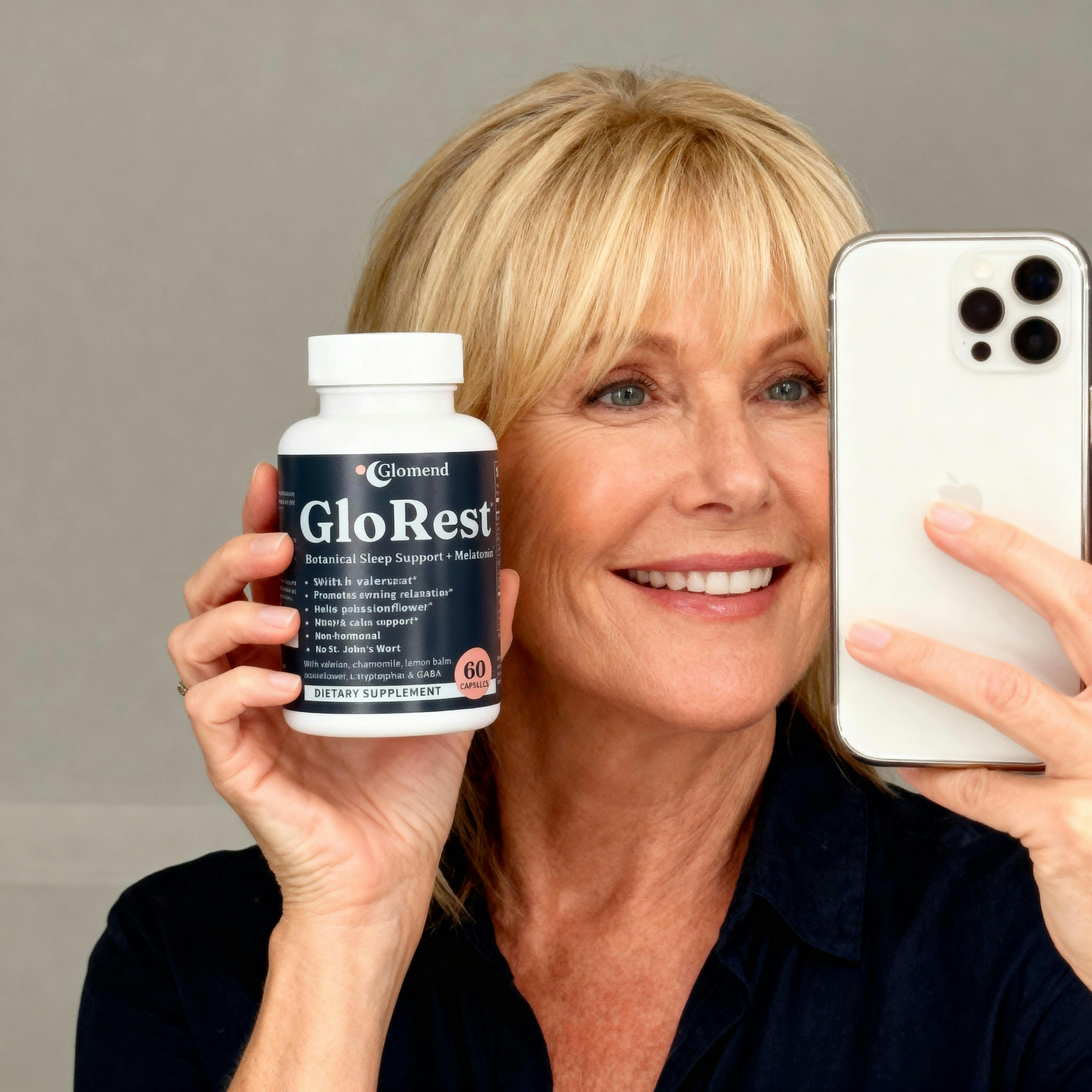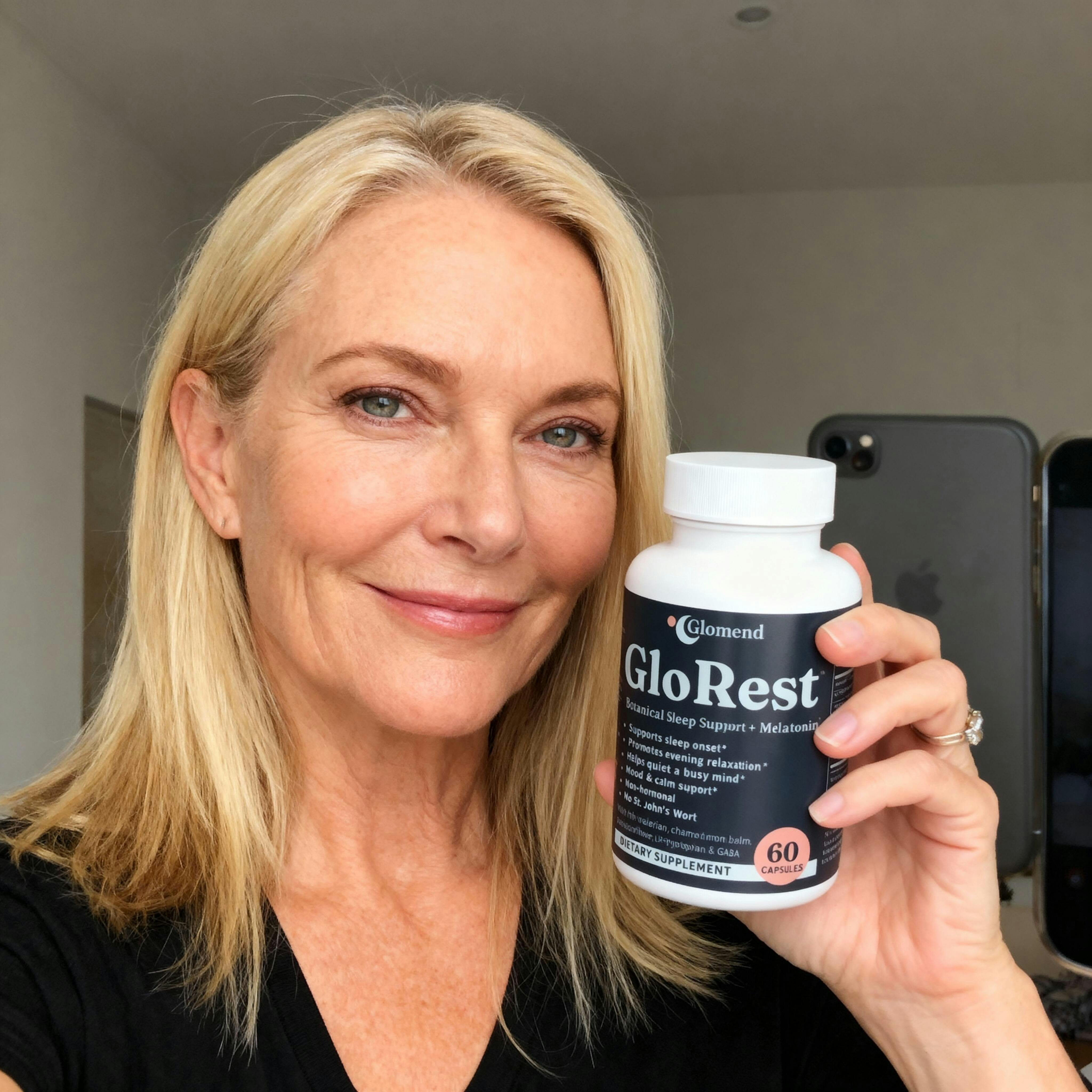
"Tried it because my sister wouldn't stop talking about it. Honestly shocked. Fell asleep easier, and when I woke at 4AM I was back asleep in about 20 minutes instead of lying there for two hours. That never happens."
 Rachel M., 52
Verified Buyer
Rachel M., 52
Verified Buyer
After six sleep supplements failed them, 4,200 women found this. Whether it's hot flashes, a racing mind, or hormone swings that jolt you awake, GloRest's 7-ingredient formula helps you fall back asleep in minutes — not hours.
Free shipping over $50 · 90-day money-back guarantee
from $39.99 · 60 capsules


You fall asleep fine. Then 3AM hits — mind racing, heart pounding, wide awake. In the Study of Women's Health Across the Nation, 38% of women aged 40–55 reported trouble sleeping, and the odds of sleep disruption run markedly higher in perimenopause than before it. It isn't in your head.
Here's what's happening. Melatonin helps you fall asleep, but it does nothing when a cortisol surge wakes you at 3AM. Magnesium relaxes your muscles but won't quiet the mental spiral. That's because perimenopause disrupts three systems at once: your stress hormones (cortisol), your calming neurotransmitters (GABA and serotonin), and your sleep-wake clock.
Most sleep aids hit one of those.GloRest's seven ingredients are formulated to support all three.
The research backs each pathway by name. A 2022 meta-analysis inNutrition Reviewsfound tryptophan supplementation measurably shortened the time it took people to fall asleep. A randomized trial inMenopausefound valerian improved sleep quality in postmenopausal women versus placebo. And a study inPharmaceutical Biologyfound GABA paired with related compounds reduced the time to fall asleep and improved non-REM sleep.
Why 3AM? Melatonin fades exactly as cortisol surges.
By 3AM melatonin's job is done and fading — but cortisol is surging. Melatonin can't touch this.
This is the piece most women are never told: you're not failing at sleep. Your biology shifted. GloRest is built for that shift.
Most supplements throw one herb at the symptom. GloRest targets the specific pathways the hormonal transition disrupts — the cortisol surge, the GABA drop, the circadian drift — in one formula you take at bedtime.
 Valerian Root
150mg
Valerian Root
150mg
Studied in postmenopausal women for improving sleep quality; helps you fall asleep faster without next-day grogginess
 L-Tryptophan
100mg
L-Tryptophan
100mg
Precursor to serotonin and melatonin; shown in meta-analysis to shorten time to fall asleep
 GABA
100mg
GABA
100mg
Supports the brain’s natural calming response; studied for reducing sleep latency
 Chamomile
100mg
Chamomile
100mg
Traditionally used to ease bedtime tension; studied for a calming effect
 Lemon Balm
100mg
Lemon Balm
100mg
Studied for supporting relaxation and easing nighttime restlessness
 Passion Flower
100mg
Passion Flower
100mg
Studied in menopausal women for supporting sleep and easing restlessness
 Melatonin
2mg
Melatonin
2mg
Supports a healthy circadian rhythm — dosed low on purpose to avoid morning grogginess

"I'd walk into a room and forget why I was there. Lost words mid-sentence in meetings. I genuinely thought it was early dementia. Turned out I'd been sleeping four hours a night for months. Three weeks on GloRest and the fog lifted. I can think again."
 Michelle M., 53 · Verified Buyer
"Look, the hot flashes didn't magically vanish. But when I wake at 2AM now, I'm back asleep in 15 minutes instead of staring at the ceiling for three hours. Four weeks in, something shifted. Sleeping 6-7 hours now."
 Amanda P., 54 · Verified Buyer
"Nine hours in bed and I'd wake up like I'd been hit by a truck. My doctor said I wasn't getting deep sleep even though I was in bed. Now I'm dreaming again — real REM sleep — and I have energy past noon."
 Patricia L., 47 · Verified Buyer
"I don't usually believe supplements. I'm the person who returns things. This one stayed. Three weeks and I slept through the night for the first time in two years."
 Lisa K., 48 · Verified Buyer
Individual results may vary. These statements have not been evaluated by the Food and Drug Administration. This product is not intended to diagnose, treat, cure, or prevent any disease.
These statements have not been evaluated by the FDA. Not intended to diagnose, treat, cure, or prevent any disease.


90-day money-back guarantee · Ships in 24–48 hours
Includes the "Simple Bedtime Tips" guide + 4 printable sleep trackers ($29.99 value) — yours to keep, even if you request a refund.
Try GloRest risk-free for three full months. If you're not falling asleep faster and staying asleep longer, email us for a full refund — even if the bottle is empty. No forms, no hoops.
Most women who quit at week 2 miss the bigger shift that lands around week 4–6. Give it the full run.
Everything women ask before their first bottle.
Yes — by design. GloRest uses 2mg, not the 10mg megadoses that leave you foggy at 7AM. Low-dose melatonin cues your sleep-wake cycle while the six botanicals handle the rest of the night.*
No. GloRest uses 2mg melatonin, not the 10mg megadoses in most sleep aids, paired with calming botanicals. Most women wake clear, not foggy. It helps you fall asleep naturally rather than knocking you out, so mornings feel like rest — not a hangover.
Some women feel a calmer evening and easier sleep onset in the first week. Most see meaningful change by weeks 2–4: falling asleep faster, fewer wake-ups. Full benefits build over 4–8 weeks as your circadian rhythm resets.
No. GloRest is supportive nutrition, not a sedative. You can take it nightly without dependency and stop anytime without withdrawal. It works with your body’s natural sleep cycle rather than overriding it.
GloRest uses just 2mg total, 1mg per capsule — gentler than typical 5–10mg pills. Start with 1 capsule to assess comfort, then move to 2. If you’re very sensitive or take sleep medication, check with your doctor first.
GloRest is designed to be safe for most adults, but if you take sedatives, blood thinners, or immune suppressants, check with your provider first. It contains no St. John’s Wort, so it avoids that common interaction risk.
GloRest works best for stress-related and perimenopause-related sleep disruption. If you have loud snoring or gasping (possible sleep apnea) or extreme daytime exhaustion despite 7+ hours, see your doctor to rule out underlying causes first.
Ships within 24–48 hours. Standard U.S. delivery is 3–7 business days. You’ll get tracking by email once it’s on the way.
You’re covered by our 90-day money-back guarantee — a full refund even if the bottle is empty.

Glomend was built for the women living this transition and getting dismissed for it — and for the rest of us headed there. We make the daytime-to-nighttime system this stage deserves, and donate 1% of net profits to women's mental health. Founded by women, for women — at every stage.


90-day money-back guarantee · Free shipping over $50
Individual results may vary. These statements have not been evaluated by the Food and Drug Administration. This product is not intended to diagnose, treat, cure, or prevent any disease.