
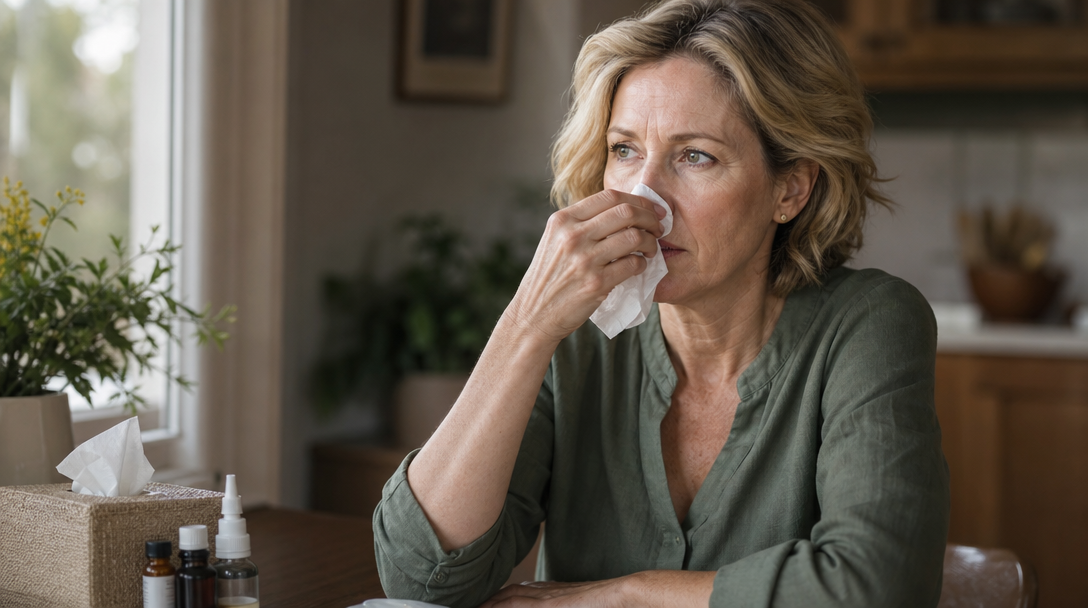
Ever find yourself getting flushed and stuffy after a single glass of red wine? Or suddenly itchy for no reason at all? For years, I just assumed I was developing weird new allergies. It was just one more thing to add to the perimenopause pile.
It might not be allergies. During perimenopause, fluctuating estrogen can disrupt how your body breaks down histamine, the compound behind allergy symptoms. This can lead to histamine intolerance perimenopause, where allergy-like symptoms have a hormonal root cause instead of a true allergic reaction.

What Is the Link Between Estrogen and Histamine Intolerance Perimenopause?
I spent so much time feeling confused. One day I’d be fine, the next I’d have a headache and a runny nose after eating a perfectly healthy salad. It turns out our hormone health is deeply tied to our body’s histamine response. When you're in perimenopause, estrogen doesn’t just decline gracefully — it goes on a wild rollercoaster ride. And that chaos can create the perfect storm for histamine issues.
Here’s the thing: research suggests estrogen has a double-whammy effect. First, fluctuating estrogen levels can interfere with the production of an enzyme called diamine oxidase (DAO), which is your gut's main tool for breaking down histamine from the foods you eat (Histamine Intolerance: Symptoms, Diagnosis, and Beyond, 2024). On top of that, estrogen can also encourage your mast cells to release more histamine into your system. So your body is struggling to clear histamine out, right as your hormones are telling it to release more. It’s a frustrating cycle. This isn't a new idea, either. An early, foundational study from 1976 first noted that a natural surge in estrogen seemed to directly influence histamine levels, hinting at this connection decades ago (Histamine metabolism and female sex hormones in women, 1976).
Why Does Histamine Intolerance Perimenopause Feel So Awful?
Think of your body as having a “histamine bucket.” Normally, your DAO enzyme works like a drain, keeping the bucket from overflowing. But during perimenopause, it’s as if the drain is partially clogged (less DAO) while the faucet keeps dripping faster (more histamine release). Eventually, a key area our GloBalance formula is designed to address. the bucket overflows. That overflow is what you feel as symptoms.

When histamine isn’t broken down efficiently, it builds up and can trigger a whole cascade of miserable, allergy-like reactions: skin flushing, hives, an itchy throat, a runny nose, headaches, and even digestive upset (Histamine Intolerance: Symptoms, Diagnosis, and Beyond, 2024). What makes potential histamine intolerance perimenopause so maddening is that the symptoms can feel completely random. You might blame the pollen count or something you touched, when it was actually the spinach and avocado in your lunch. It's confusing, and honestly? That's exhausting.
What This Means for You
First, take a deep breath. You’re not imagining things. If you’ve noticed new or worsening perimenopause allergy symptoms that don’t quite add up, this estrogen and histamine connection is a very real possibility. The connection is still an active area of wellness research, but acknowledging it is the first step. Pay attention to your body. You might consider keeping a simple journal of your food and symptoms to see if you can spot any patterns.
This isn't something you have to figure out alone. It's a conversation worth having with a doctor or a trusted healthcare professional who understands hormone health. They can help you rule out true allergies and other conditions. For some people, dietary adjustments can make a difference. And some research has shown that oral supplementation with the DAO enzyme may help support the breakdown of dietary histamine in the digestive tract, potentially improving symptoms for individuals with histamine intolerance (Evidence for Dietary Management of Histamine Intolerance, 2024). The key is to get clear on what's really going on in your body.
Frequently Asked Questions
Can perimenopause cause new allergies?
It’s possible, but what feels like a new allergy might actually be histamine intolerance. The symptoms—like itching, stuffiness, and flushing—are very similar. But it's often caused by your body's decreased ability to break down histamine, a problem linked to the hormone fluctuations of perimenopause.
What’s the difference between histamine intolerance and a true allergy?
A true allergy involves a specific immune system (IgE) response to a substance. Histamine intolerance isn't an immune reaction; it’s more of a breakdown issue. It happens when your body accumulates more histamine than your DAO enzyme can get rid of, causing a buildup and symptoms.
How do I know if I have histamine intolerance from perimenopause?
You can’t reliably self-diagnose this, as symptoms overlap with many other conditions. The best path is to talk with a healthcare professional. They can help you investigate your symptoms, rule out other causes like MCAS, and determine if histamine intolerance perimenopause is a factor for you.
Sources
This statement has not been evaluated by the Food and Drug Administration. This product is not intended to diagnose, treat, cure, or prevent any disease.