
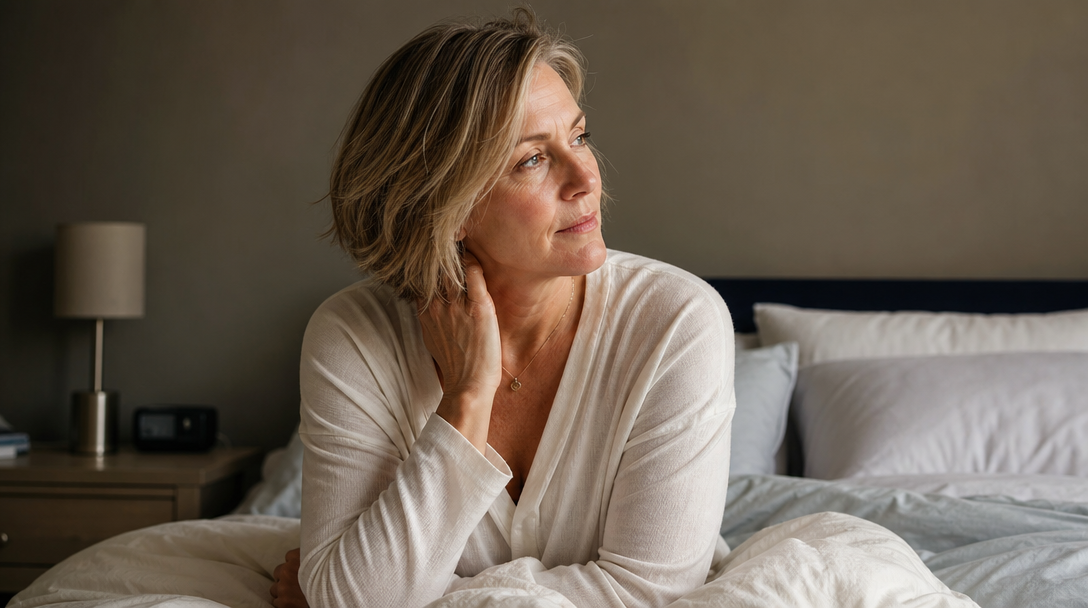
My husband was the one who told me. He said I’d started snoring, and sometimes I’d make a little gasping sound in my sleep. I’d never snored in my life. And I was so, so tired.
If you're suddenly snoring, gasping, or waking up feeling like you ran a marathon overnight, you're not going crazy. There’s a well-documented perimenopause sleep apnea link. Declining hormones, especially progesterone, can affect the muscle tone in your throat, which may contribute to these unnerving new sleep issues and disrupt your deep rest.

How Do Hormones Create the Perimenopause Sleep Apnea Link?
I get it. This one sounds strange. We're used to blaming hormones for hot flashes and mood swings, but breathing? It feels like it should be off-limits. Here's the thing: progesterone does more than just regulate our cycles. It also acts as a natural respiratory stimulant, helping to keep the muscles in our upper airway firm and open (Paloma Health, 2024). It’s a quiet, background job we never notice.
But when progesterone starts its slow decline in perimenopause, that support system can weaken. Your airway might become a bit more collapsible, especially when you're relaxed during sleep. This isn't just a guess; research has found a significant connection between lower levels of both estrogen and progesterone and an increase in snoring and self-reported apnea symptoms in women going through this transition (New Scientist, 2023).
Is the Perimenopause Sleep Apnea Link a Common Problem?
It's far more common than you'd think, which is probably why it feels so isolating when it happens to you. For years, sleep apnea was seen as a man's issue. The reality is that the risk for women changes dramatically with age and hormonal shifts. The prevalence of sleep disorders overall jumps from as low as 16% in early perimenopause to as high as 60% in postmenopause (Sleep Disturbance and Perimenopause: A Narrative Review, 2025).

Sleep-disordered breathing is a huge piece of that puzzle. In fact, it’s now recognized as one of the three main categories of sleep disturbances that show up during the menopausal transition (Sleep, Melatonin, and the Menopausal Transition..., 2017). The strong perimenopause sleep apnea link helps explain why so many of us go from being "good sleepers" to waking up exhausted for no apparent reason.
So It's Not Just Annoying Snoring?
Exactly. The snoring is the symptom that gets all the attention, but the real problem is what’s happening underneath. Those gasps or pauses in breathing are called apneas. Each time one happens, your body senses a drop in oxygen and briefly pulls you out of deep sleep to restart your breathing. You might not even remember it in the morning.
But your brain remembers. It's this constant interruption that fragments your sleep architecture and prevents you from getting the restorative deep sleep you need. And that’s a direct line to the next-day brain fog, the bone-deep exhaustion, and the feeling that you just can't function. Exploring the perimenopause sleep apnea link is about understanding the root cause of why you feel so worn out.
What This Means for You
First, and most importantly: you are not imagining this. What you're experiencing is real, it’s physiological, and there's a hormonal reason for it. For me, just knowing that was a huge relief. It wasn't just "getting older" or "stress."
This information isn't meant to scare you. It’s meant to give you a starting point. If your sleep has taken a nosedive and you or your partner have noticed snoring or gasping, this is worth bringing up with your doctor. Understanding the potential perimenopause sleep apnea link can help you ask the right questions and have a more productive conversation about what’s really going on with your wellness journey.
Frequently Asked Questions
Can perimenopause make you start snoring?
Yes, it can. During perimenopause, the drop in progesterone may lead to reduced muscle tone in your upper airway, making it more likely to vibrate or collapse slightly during sleep. This change is a primary reason why many women who never snored before start to during this time.
Does sleep apnea risk increase after menopause?
Research suggests it does. Some studies show what's called a "dose-response" relationship, meaning the risk for sleep-disordered breathing may increase as women progress through the menopausal transition (Menopause Is Associated with Obstructive Sleep Apnea..., 2023). The continued low levels of key hormones are a contributing factor.
Which hormones are connected to the perimenopause sleep apnea link?
Both progesterone and estrogen are involved. Progesterone acts as a respiratory stimulant and helps maintain airway muscle tone (Paloma Health, 2024). Studies have connected lower levels of both hormones to a significant increase in snoring and other symptoms of sleep-disordered breathing in menopausal women (New Scientist, 2023).
Sources
- How Do Perimenopause and Menopause Affect Your Sleep? (2024)
- Sleep apnoea symptoms in post-menopausal women linked to low oestrogen (2023)
- Menopause Is Associated with Obstructive Sleep Apnea in a Dose-Response Manner: Real-World Data from a Cross-Sectional Study (2023)
- Nutritional interventions in treating menopause-related sleep disturbances: a narrative review (2024)
- PubMed Database (N/A)
- Sleep, Melatonin, and the Menopausal Transition: What Are the Links? (2017)
- Sleep Apnea and Menopause (2025)
- Sleep Disturbance and Perimenopause: A Narrative Review (2025)
- Impact of sleep disturbances on health-related quality of... (2026)
This statement has not been evaluated by the Food and Drug Administration. This product is not intended to diagnose, treat, cure, or prevent any disease.